Thursday, July 06, 2006

Life (with Radishes & Prosciutto) is Beautiful

A Note, by Wislawa Szymborska

Life is the only way
to get covered in leaves,
catch your breath on the sand,
rise on wings;

to be a dog,
or stroke its warm fur;

to tell pain
from everything it's not;

to squeeze inside events,
dawdle in views,
to seek the least of all possible mistakes.

An extraordinary chance
to remember for a moment
a conversation held
with the lamp switched off;

and if only once
to stumble upon a stone,
end up soaked in one downpour or another,

mislay your keys in the grass;
and to follow a spark on the wind with your eyes;

and to keep on not knowing
something important.
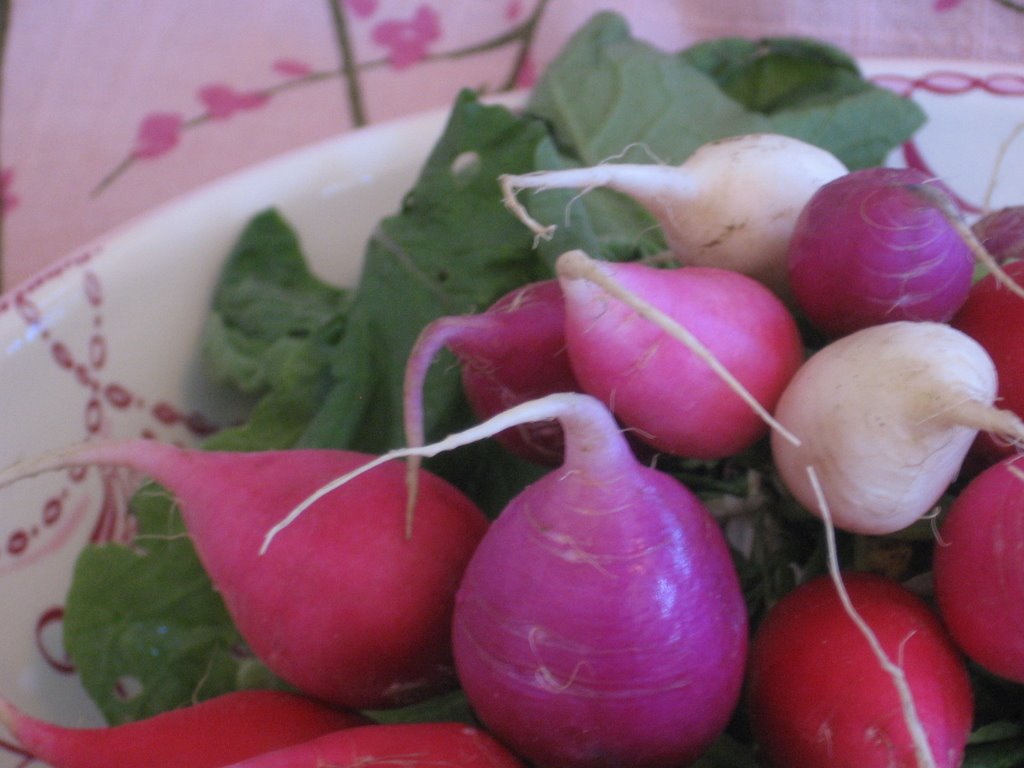
Be careful what you wish for … I disagree. I am now six days into something that I have wished for often over the past two years, and I’m glad that I wasn’t careful.

Last month, I quit my job of four years, and as a fitting farewell for my last day, which was Friday, my coworker-in-crime, Sylvie, took me to a screening of The Devil Wears Prada. I’m grateful to have had that job, for the work itself, which I enjoyed, and for the financially secure footing it put me on, but I’m even gladder that there was a straw that finally broke the camel’s back. Because of that silly straw, I emailed my publisher at Things Asian and said, “I want to quit X-job, where I'm not happy. I want to do something that makes me really, really, really happy. May I work for you?" My publisher, a man of generosity, kindness, creativity, and integrity, said … yes. Sigh! As of August first, (after taking the month of July off), I will be the managing editor of the To Asia With Love guidebook series.

A beautiful life requires proactive efforts, something I had forgotten in recent years and was reminded of, in all places, in the world of food blogging. As I began reading food blogs in April (I know, I’m a Jane-Come-Lately), I discovered people around the world who lovingly, zestfully, exuberantly, and quietly incorporate life’s greatest pleasure into their lives. Reading Chocolate & Zucchini, I think of both MFK Fisher and Laurie Colwin. The words are so light, and by that I do not mean frivolous, but filled with radiance. Reading Orangette, I remember my own twenties, living in Seattle, working at the Elliott Bay Bookstore, teaching myself how to cook and reading Gourmet—I thought I was the height of sophistication when I got my own subscription. I have already made a new blog friend, Anni, who sent me the most amazing fig confiture, and who is inspiring me now by making her own cheese.

Yes, a straw broke the camel’s back and prompted me to quit, but it was all those lovely food blogs out there that pushed me to ask for the job I really desired and reminded me how I want to live my life once again now that I’m free. Just when you think life is too busy dealing you blows—the loss of my beloved Grammy, the loss of a former boyfriend, a mean boss, this really messed up world—it comes up with some crazy way to remind you that it is also a thing of great beauty. Reminds me that I was very lucky to have had Grammy for so long in my life, to have had that former boyfriend who taught me how to appreciate the value of words and faith, to have had a job where I could write all day, to have the privilege of living in this world no matter how messy it is. Free from my old job and inspired by the always positive words of foodies around the world, I spent this weekend celebrating ...

Reading for hours on end the way I used to when I a kid: The History of Love gives me hope in the future of American literature! … Going to the Hollywood Farmer’s market with my sister and friend, Lisa, and buying apricots, artichokes, tamales, bread, grapefruit, and radishes so beautiful they inspired me to spend that night working on an enormous painting for the living room … Sorting through all the recipes I cut out of magazines over the past five years and actually making two of them (the sun-dried tomato tart was nice and the butterscotch biscotti a dud) … Cleaning up the novel I began 10 years ago so I can finally send it to agents … Starting a batch of nocino for Christmas gift-giving … Replanting my balcony garden with herbs and geraniums … Eating and drinking with my sis and our friend, Vickie, who is house-sitting for a friend with a pool—L.A. has never been hotter, and a pool never more enjoyed.

I haven’t cooked anything in the past few weeks that dazzled me, so I’m going to share a favorite recipe. This is a hit every time I take it to a party. And since prosciutto is yet one more thing in life to celebrate—I would nominate it for its own food group, if such a thing was possible—I want to pass it on.

Prosciutto & Artichoke Involtini
(from Food & Wine magazine)


Ingredients:

- 1 tsp extra-virgin olive oil
- ½ cup slivered blanched almonds (2 oz.)
- 1 can artichoke hearts (not marinated), drained and patted dry
- ¼ cup cream cheese, softened
- 2 Tbls freshly grated Parmesan cheese
- ½ tsp finely grated lemon zest
- Salt and freshly ground pepper
- 18 thin slices of prosciutto

Directions:

1) Heat the oil in a small skillet.
2) Add the almonds and cook over moderate heat, stirring, until golden, about 5 minutes. Transfer to a plate and let cool.
3) In a mini food processor, pulse the artichoke hearts with the almonds until finely chopped.
4) Add the cream cheese, Parmesan and lemon zest and process to a paste.
5) Season with salt & pepper.
6) Lay 3 prosciutto slices on a work surface, overlapping them slightly along the sides.
7) Spoon 2 tablespoons of the artichoke filling onto the short end and roll into a tight cylinder. Repeat with the remaining prosciutto and filling.
8) Trim the ends, cut into quarters & serve.
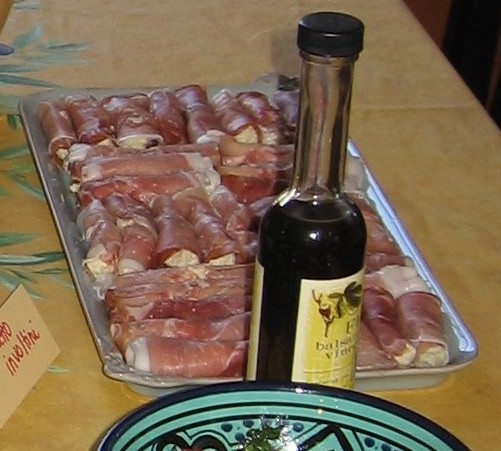
A platter of Prosciutto Involtini
People actually speak with reverence about this appetizer ...
YOU MUST TRY IT!

Saturday, June 24, 2006

Strawberry Wine Forever

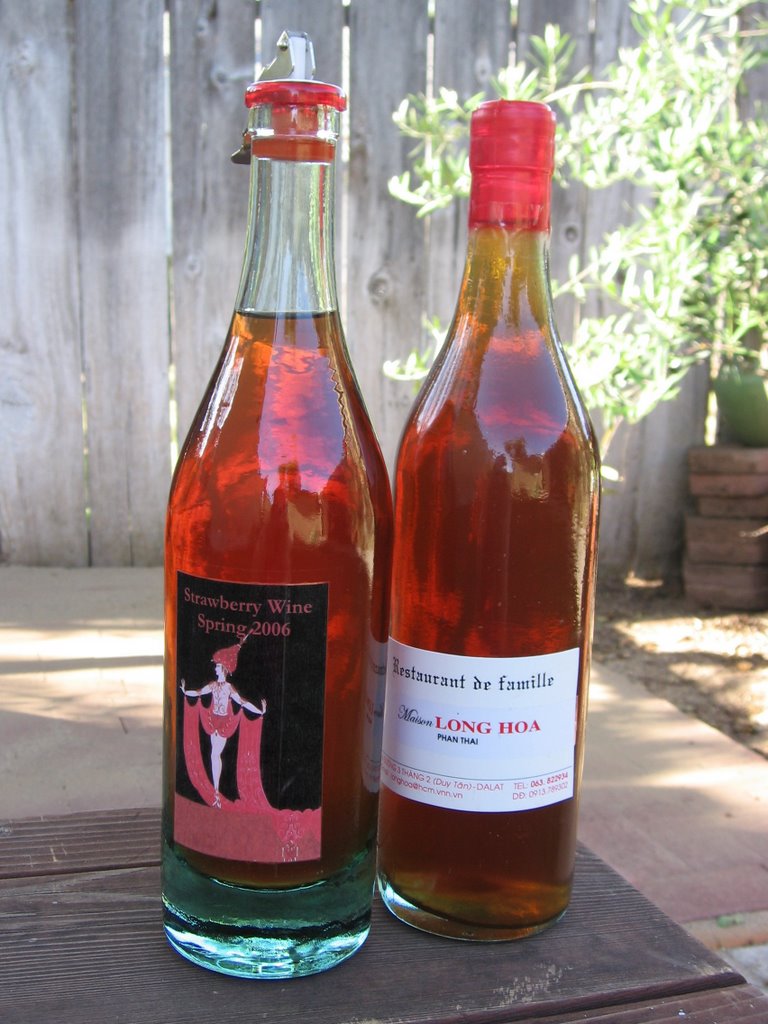
My version and the bottle from
Maison Long Hoa in Vietnam.

I need to make something clear. Despite that two of my first five posts on Serve It Forth are about making alcohol, I am not a boozehound. I kept only a few of the 25 bottles of limoncello that I recently made (and these I saved for sipping with friends), and the strawberry wine I am writing about now is a crucial part of Communion. Most Vietnamese women I know make their own fruit liqueurs to serve after meals as digestifs.

I first had strawberry wine in the fall of 1995, in the hill town of Dalat, about six hours north of Saigon. It was my first weekend out of the city, and I needed the escape from hot urban living. Cool and quiet, Dalat is home to the Dalat Palace, my favorite hotel in the world, and Maison Long Hoa, a hushed, simple, elegant Vietnamese restaurant where Beethoven rather than ABBA plays over the stereo. As my then boyfriend and I chatted with the ever-gracious owner, Mr. Thai, he suggested we try the restaurant’s strawberry wine, which was made by his wife. It was three years old, and it was syrupy, sweet, and good. We bought two bottles with the intention of saving them for special occasions back in Saigon. Instead, we drank both by the time we got back to the hotel. In our defense, it was a long walk back, with digressions into shuttered market stalls to try on hats, and the Stop & Go during the blackout hour for flamenco music and an impromptu poetry writing session. And yes, we had hellacious headaches the next morning.

When my sister and I traveled back to Vietnam last year to research Communion, we stopped in at Maison Long Hoa, for clay pot fish, beef in la lot leaves and some strawberry wine. Mr. Thai’s wife still makes it, and it is still good. We bought a bottle, and later, when I was talking about it with our local translator, Linh, I was told that every good housewife in Dalat knows how to make it. It’s easy, she assured me. She gave me her recipe to try at home. I started a first batch this January, and a second batch in April. The first batch was in bottles in March. I have to say, when I looked at that jewel-like red liquid in those three bottles, I was very proud of myself. And so I took a bottle to the big Vietnamese feast we cooked for our friends and a small group of winemakers last month in Paso Robles.

We shouldn’t have waited until the end of the night to sample it. Everyone had had a little too much to drink by then, and people were in playful but feisty moods. The winemakers first sampled a Vietnamese made red table wine that Julie and I brought, and they made a big show of sputtering, spitting it out, and wrinkling their noses. Out of the kindness of his heart—when it came time for my strawberry wine—the owner of L’Aventure assured me that he liked its berry notes. My friend Joel smilingly announced, “Well, at least this one’s drinkable.” And then one of Joel’s colleagues, Soren, commented on the slightly brown tint of the liquid and gave me a well-intentioned half-hour lecture on oxidization and bacterial fermentation. I just wanted to put fruit and sugar in a jar and see if I could make booze like all my friend’s moms do in Vietnam. I decided not to bust out Mr. Thai’s wife’s wine for such unforgiving criticism, and instead kept it for a crowd I was sure would appreciate it: my undiscriminating girlfriends.

A few weeks later, Julie and I gathered with Michelle, Hilary and Sarah at our friend Vickie’s house on a Sunday afternoon for a barbecue. Before the festivities got underway, I asked them to do a taste test with the Vietnamese strawberry wine and my wine. I knew I could count on my girls. They liked both, but they liked mine best. They said you could really taste the fresh strawberries in it. I guess that would be the “berry notes” mentioned up in Paso! The Vietnamese version was much darker and richer, perhaps because it had been in the bottle for two years. Michelle decided that it tastes like a white port. She also compared both versions to Manischewitz, which might not be taken as a compliment unless you know how much Michelle likes that saccharine wine. All were impressed by the fact that I’d even made wine—thank you, ladies!—and a long discussion ensued, led by my sister, about the possibilities, had we known as teenagers that it was so easy to make wine in a jar. We also decided that strawberry wine is very nice chilled over ice.

I am the first to admit that my winemaking efforts are uneducated and crude (I know nothing about fermentation, alcohol content, and so on), but at the same time, the result made me happy. I think I’m going to try apricot wine next. In the meantime, here is the end result of how I did it. If anyone has suggestions or recommendations, feel free to send them my way.

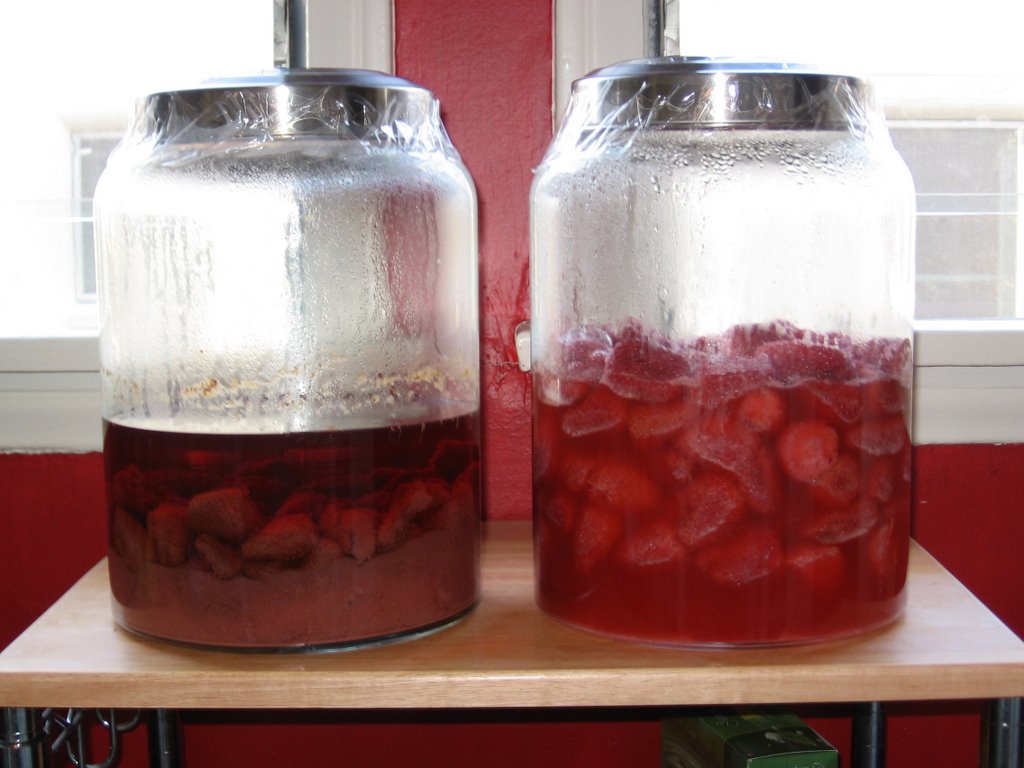
Batch 1 & Batch 2 - Both jars are too big ... too much air at the top.

Linh’s Strawberry Wine

Ingredients:

- 1-gallon jar with a lid
- 10 lbs strawberries
- 2 lbs sugar

Note on Fermentation: If you live in a cold place, you should add a bit of wine yeast.

Directions:

- In the jar, put one layer of strawberries, one layer of sugar, one layer of strawberries, one layer of sugar, and so on until all the strawberries are used up.

- If you live in a cold place and don’t get much sun, mix half a 5-gram packet of wine yeast according to the instructions, and dribble this into the jar.

-Put the lid on the jar and keep it in a warm place (75-80F) for two months. I kept mine in a window where it could get direct sunlight in the afternoons.

- Manually filter the liquid using a plastic screen, Vietnamese style—these are Linh’s instructions, and I love them, although I don’t know what they mean. Below I explain how I filtered the wine. I’m sure my method is equally rudimentary. The liquid should be clear and deep ruby pink in color.

- Pour filtered liquid into a jar and let it sit for another week or two, to let the final sediment sink to the bottom.

- Strain this liquid from the sediment.

- Bottle wine and make beautiful labels.

- Let wine sit for at least another month—more if you have patience—before drinking.

NOTES ON THE PROCESS

Amounts:
The first time I made this I used 5 lbs. strawberries, the second time I doubled the recipe and used 10. Oddly, the first batch yielded more wine than the second. I have no idea why. From the 10 lb. batch, expect approximately two 750ml worth of liquid.

Oxidization:
When putting the strawberries into the jar, don’t leave a lot of air at the top. The jar should be full with just an inch or so of space at the top, to keep the liquid from turning brown.

Fermentation:
Fermentation begins after about five days. It’s fun to watch the concoction start to fizz and bubble. Mine fizzed and bubbled for about a month before becoming just a weird-looking science project in the kitchen. I have seen jars of wine in the making in my Vietnamese friends’ houses. In every case, the fruit rises to the top of the liquid and stays there. In my case, the fruit rose during the first month, and then sank during the second. The strawberries began to look like mushy little sea anemones, sleeping on a thick bed of sediment, and many a visitor compared them to things that I do not want to write about in an essay on food. My advice: just be patient and see what happens. I honestly thought the whole project was going to be a big waste of time, but I now have a few bottles of yummy wine that prove the Doubting Debbie in me wrong.

Potential Explosions:
Linh’s instructions call for an airtight jar. Apparently, if the jar is truly airtight, it will explode. I did not know this, and since I sealed my jar as best I could, I am going to assume that it wasn’t completely airtight. You may want to do more research on this before blowing up a big jar of strawberries in your kitchen.

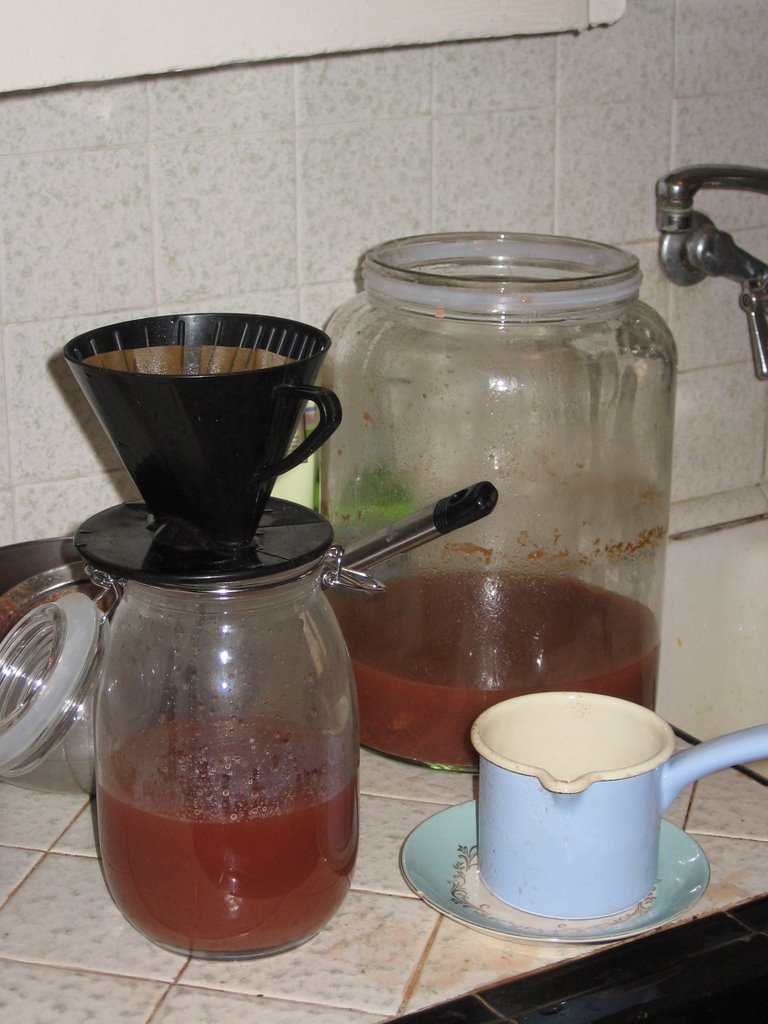
My first crude attempts to filter ...

Filtering:
I have no idea how to filter wine, and so, when confronted with the first batch, I used the only filtering system I know: my coffee filter. My one-cup coffee filter, to be precise. I can’t say my approach was the most efficient, because, as you can see from the two small photos above, I attempted to strain out the strawberries first. What I should have done—and what I did with my second batch—was scoop the liquid out first, and then filter that liquid. I filtered the liquid three times to get it as clear as possible.

Then I put that liquid into a jar, let it sit for two weeks, and VERY CAREFULLY scooped out the liquid, leaving behind the small quarter-inch layer of sediment on the bottom of the jar. I know there are better ways to do this, but I approach these activities as a kind of meditation, and I think half the fun is discovering what you can do, without having any idea what you’re doing.

My second more "refined" attempt to filter ...

Flavor:
Right after you have filtered your wine, it will taste a little bitter. It needs to sit in the bottles for a month or so to sweeten up.

Tuesday, June 06, 2006

Simple Pleasures: Shrimp with Lime

Some of my fondest food memories in Vietnam involve seafood, beginning with an outing that occurred just a few months after I moved to Saigon, more than 10 years ago. Three sisters (one of them a student in an English class I taught) took me to a crab shack in Chinatown. The shack was located on a “crab street,” where every shop served the same savory crab smothered in tamarind sauce: my student insisted the one she took me to was the best ... naturally. We ate with our hands and tossed the shells onto the floor once we'd picked each claw clean. As we walked out of the restaurant, leaving behind empty beer glasses smeared with the sticky, dark brown pulp of the sauce, little pieces of tamarind-glazed shells stuck to our flip-flops, and we were destined to become friends for life.


Hoi An Fish Market, photo by Julie Fay Ashborn

On this last trip back in October 2005, seafood played a prominent role during visits to the coastal towns of Hoi An, Nha Trang and Phan Thiet. My sister Julie and I found ourselves obsessed with squid, even though neither of us is a fan at home, barring the deep-fried calamari appetizer we occasionally order when afflicted with lack of imagination. The squid in Vietnam has a flavor so pure, so of the sea---without being briny---that I am still trying to find just the right words to describe it. In Phan Thiet, with the fabulous Jon Bourbaud, Executive Chef at the Novotel, we marinated just-off-the-boat squid fillet in lemongrass, chili and cilantro, dipped it in nuoc cham, tasted, and swooned. The key to this dish’s success: freshness and simplicity.

Simplicity is behind one of my favorite nibbles in Vietnam: grilled shrimp with lime juice, salt, and pepper. This basic sauce is common, and I have also enjoyed it with grilled beef and grilled chicken. But I’m sticking with shrimp here, because it makes such a perfect summer appetizer. In preparation for the book, Julie and I have catered two parties: a trunk show for 75 for my friend Connie, a fellow writer and talented jewelry designer, and a dinner party for 25, at the house of our friends Joel and Dagny in Paso Robles. Along with the clay pot fish and banana flower salad that Julie has perfected---sorry, I’m holding out on this one, you’ll have to wait for the book to get the recipe---we served this grilled shrimp, and both times, people raved.

Grilled Shrimp with Lime, Salt and Pepper

Ingredients:

- Fresh, uncooked shrimp, as much as you want to feed however many you’d like
- Lime juice
- Good sea salt
- Fresh ground pepper
- Skewers, pre-soaked in water, so they won't burn on the barbecue

Instructions for the Shrimp:

1. Fire up your barbecue.
2. Brush the shrimp with oil. I like peanut oil, but at the dinner party in Paso, Joel pulled a bottle of Pasolivo Lime Olive Oil from his cupboard. The oil is from the local Pasolivo olive estate, owned and operated by our friend Joeli Yaguda and her family. The company’s distinctive oil, blended with lime, gives the shrimp a soothing flavor that reminds me a bit of the soft vanilla-citrus quality of kaffir lime leaves. You could choose to braise your shrimp with this oil and skip the sauce altogether, and you would still have a wonderful appetizer, but I recommend giving the sauce a try.
3. Skewer the shrimp.
4. Grill the shrimp.

Instructions for the Sauce:

1. Squeeze lime juice into small dishes (however many you want to scatter around).
2. Add sea salt and ground pepper to make a watery paste. I apologize for not offering precise measurements, but this is definitely a dish you should create to taste.

A Note on Salt
Recently, we tested this dish on our parents, using the following flavored salts:

Nuoc Mam (Fish Sauce) Salt:
This salt was given to me by Didier Corlou, the Executive Chef at The Metropole in Hanoi. It is offensively stinky, but when mixed with the lime, it neutralizes nicely. Because the salt is one of Didier’s creations---he is a mad culinary scientist, as well as master chef---it’s not available for purchase. But you might be able to create the effect by mixing a bit of fish sauce with your lime juice.

Lime-Coconut Salt:
We also used a packet of lime-coconut salt that Joeli gave us. I liked the addition of coconut a lot. I am trying to track down the name of the company that makes this salt. In the meantime, if you want to try it, I suggest shaving some fresh coconut meat into your lime mixture. You might even dribble in a little coconut milk, too.


To order Pasolivo Lime Olive Oil, go to Pasolivo